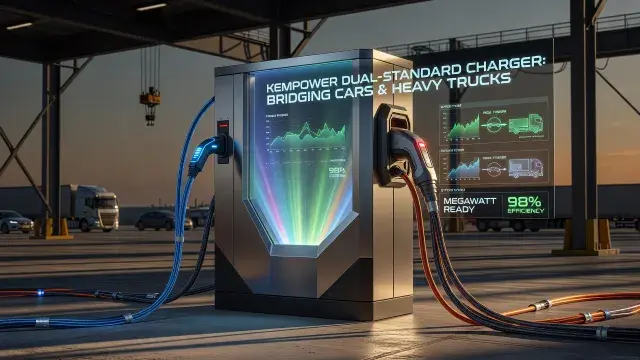
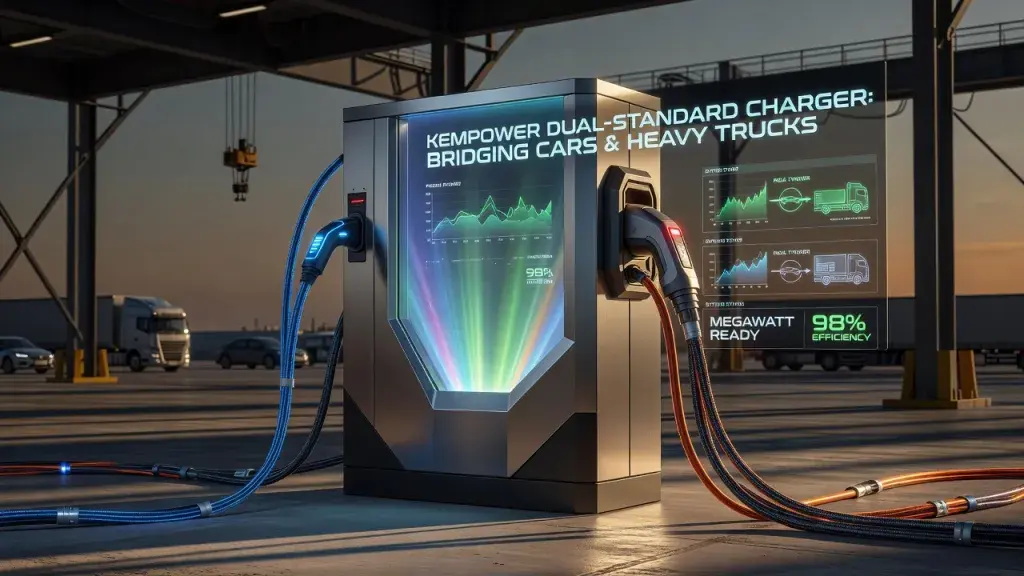
Kempower has introduced a charging dispenser designed to solve one of the most expensive problems in electric vehicle infrastructure: building separate systems for cars and trucks. The new Mega Satellite Flex supports both the established CCS standard, delivering up to 560 kW, and the emerging Megawatt Charging System, capable of pushing up to 1.2 MW to heavy-duty trucks. It marks the first time the Finnish charging manufacturer has combined both standards in a single unit.
The timing reflects where the charging industry actually stands right now, not where it eventually wants to be. CCS remains the dominant connector for passenger EVs across North America and Europe, while MCS is still in its early rollout phase, built specifically for freight trucks and other commercial vehicles that need to recharge large battery packs in short windows. Rather than betting entirely on one standard, Kempower built a device that can serve both, letting a single charging site accommodate a passenger sedan and a semi truck without duplicating hardware. For drivers curious about optimizing their own charging setups at home, resources like how to configure a VPN on Windows 11 illustrate the same underlying principle now shaping public infrastructure: flexible systems that adapt to different needs without requiring separate installations for every use case.
Why One Dispenser for Two Standards Matters
Charging site operators have faced a costly dilemma as electrification spreads beyond passenger cars. Building for CCS alone risks leaving a site unable to serve trucks as MCS adoption grows. Building for MCS alone ignores the much larger population of cars currently on the road. Kempower's approach avoids that choice altogether. A single Mega Satellite Flex unit can serve either standard from day one, meaning an operator doesn't need to guess which technology will dominate a given corridor or return years later to add a second system.
The unit also supports 800-volt EVs, a battery architecture increasingly common in newer vehicles because it allows faster charging without the thermal and efficiency penalties associated with older 400-volt systems. That compatibility means the charger isn't just bridging two standards, it's also positioned to handle the next generation of vehicle electronics as they reach the market.
Technical Specifications and Site Integration
The Mega Satellite Flex is built to handle serious current loads on both sides of its dual capability. Key specifications include:
- Up to 1,500 amps for Megawatt Charging System connections
- Up to 700 amps for CCS connections
- A 5-meter (16.4-foot) cable for CCS charging
- A 2.7-meter (8.86-foot) cable for MCS charging
- Optional integrated payment terminal
Because the unit is compatible with Kempower's existing distributed charging architecture, operators already running Kempower systems can add the Mega Satellite Flex without reworking their underlying power infrastructure. That compatibility lowers the barrier to adoption for site owners who have already invested in the company's technology.
Utilization and the Economics of Charging Sites
For any charging operator, the central financial question is utilization: how often a unit is actually delivering power rather than sitting idle. A dispenser that only serves cars, or only serves trucks, limits the pool of vehicles that can use it at any given time. By serving both categories, the Mega Satellite Flex is designed to keep utilization higher across a broader mix of traffic, which directly affects how quickly an operator recovers the cost of installation. Kempower revealed the charger at its Unplug & Recharge event held alongside ACT Expo this week, with sales expected to begin in North America and Europe in July 2026.